Subterranean termite defense in Houston requires managing both native subterranean species and aggressive Formosan subterranean colonies. Soil types across Harris County, particularly the heavy Beaumont and Lake…
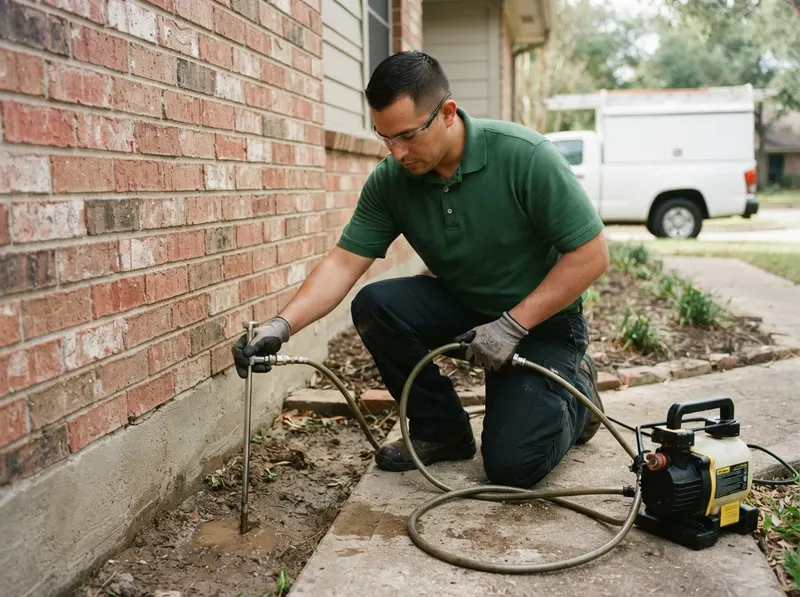
Subterranean termite defense in Houston requires managing both native subterranean species and aggressive Formosan subterranean colonies. Soil types across Harris County, particularly the heavy Beaumont and Lake Charles clays found near Memorial, Meyerland, and The Heights, expand and contract with seasonal rain patterns. This shifting soil breaks poorly applied liquid chemical barriers, creating hidden access channels. Subterranean termites require continuous ground contact for moisture, building earthen shelter tubes upward over grade beams, plumbing penetrations, and expansion joints to access structural pine framing.
A complete application relies on continuous perimeter trenching measuring 6 inches wide by 6 inches deep, saturated with non-repellent termiticide at a standard rate of 4 gallons per 10 linear feet. For structures with abutting flatwork, such as driveways in Oak Forest or covered patios in River Oaks and West University Place, technicians drill vertical holes through the concrete slab every 10 to 12 inches to inject termiticide directly into the underlying sub-grade soil. Properties bordering dense tree canopies near Kingwood or bayou waterways in Montrose benefit from perimeter bait systems spaced 10 to 20 feet apart, which worker termites feed upon and transfer throughout the subterranean colony to suppress reproduction.
Selecting liquid barrier treatment over in-ground baiting depends directly on immediate structural presence. If live worker termites are actively foraging inside wall cavities, non-repellent liquid saturation halts entry immediately, whereas bait stations require 60 to 90 days for full colony elimination through growth regulator distribution. The trade-off involves invasive concrete drilling for liquid applications versus ongoing inspection schedules for bait systems. In high-moisture drainage zones near Clear Lake, integrating structural moisture repairs with barrier placement stops colony re-establishment, preserving framing without broad chemical broadcast over landscaping.
Every job gets a firm, written price after a free on-site visit.
Tell us about your subterranean termite treatment job in Houston and we'll send a clear, written quote, usually the same day.
 Homestead Pest Control