Targeting bed bugs along the upper Texas Gulf Coast requires addressing the humid subtropical climate of Harris County, where indoor ambient humidity accelerates insect reproductive cycles. High residential density in…
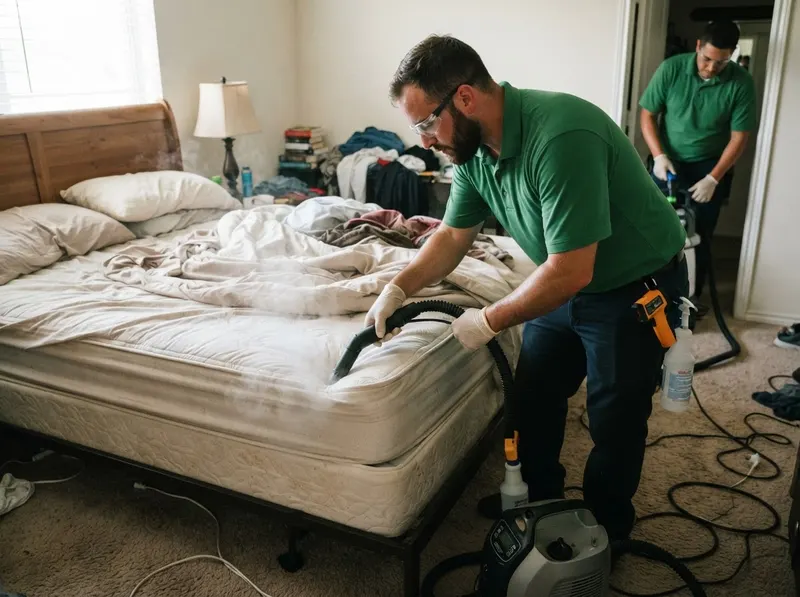
Targeting bed bugs along the upper Texas Gulf Coast requires addressing the humid subtropical climate of Harris County, where indoor ambient humidity accelerates insect reproductive cycles. High residential density in multi-family units across Montrose and historic pier-and-beam bungalows in The Heights present distinct structural voids where colonies nest. Thermal eradication forces lethal heat convection through drywall, subflooring, and dense upholstery, raising ambient air temperatures to 135 degrees Fahrenheit. This critical threshold denatures the physiological proteins of the insects within 90 minutes, eliminating both mobile adults and heat-tolerant eggs without requiring item disposal.
A dual-modality strategy pairs this thermal deployment with EPA-registered residual chemical barriers around the foundational perimeter and room perimeters. While heat addresses 100 percent of exposed interior insects immediately, chemical applications counteract deep insulation migration in larger homes throughout Memorial, River Oaks, and Kingwood. Microencapsulated non-repellent formulations are laid along tack strips, baseboards, and plumbing penetrations. When emerging nymphs encounter the dried microcapsules, the active agent transfers across the insect cuticle, neutralizing individuals that attempt to harbor within insulated external wall chases.
Property owners evaluating single-application heat versus isolated liquid applications face specific physical trade-offs. Standalone liquid insecticide programs cost less initially but demand 3 to 4 sequential visits over a 6-week developmental cycle to treat newly hatched eggs, carrying a risk of synthetic pyrethroid resistance. Thermal convection eliminates all generational stages in one 8-hour period, though sensitive electronics, paraffin candles, oil paintings, and aerosol containers must be removed prior to equipment activation. Residences in low-lying zones near Buffalo Bayou Park or Meyerland also require precise humidity monitoring during the heat-up cycle to prevent adhesive softening on laminated structural trim.
Preparation standards dictate eradication success across single-family residences in West University Place, Oak Forest, and waterfront properties in Clear Lake. Inhabitants complete a 14-step preparation checklist before technicians engage industrial blowers and monitored thermocouple sensors. Technicians position digital temperature probes inside the densest mattress centers and deep closet shelving, recording sustained lethal heat for 180 continuous minutes before tapering down. This protocol creates an unbroken perimeter defense, securing human habitats against persistent vector resurgence.
Every job gets a firm, written price after a free on-site visit.
Tell us about your bed bug thermal and chemical eradication job in Houston and we'll send a clear, written quote, usually the same day.
 Homestead Pest Control