Red imported fire ants thrive in the hyper-humid environment and heavy clay subsoils common to Southeast Texas. In dense neighborhoods such as West University Place, The Heights, and Oak Forest, turf irrigation systems…
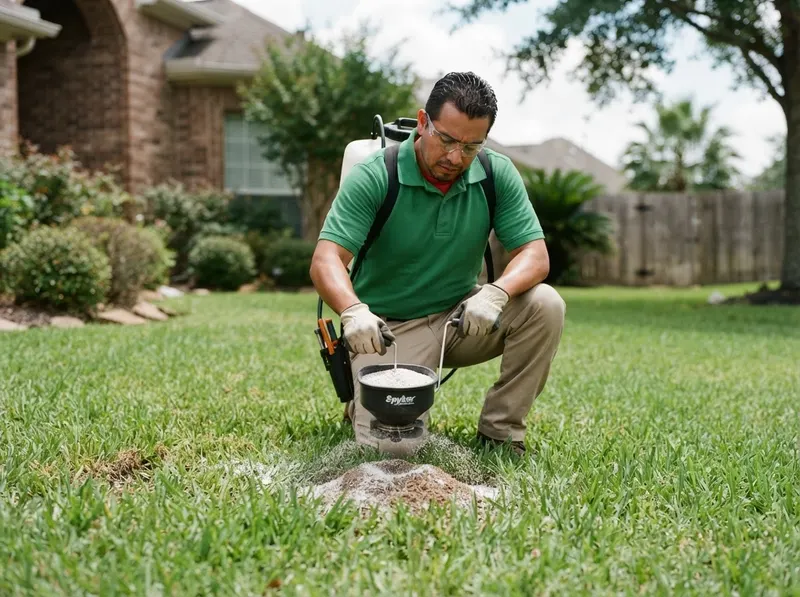
Red imported fire ants thrive in the hyper-humid environment and heavy clay subsoils common to Southeast Texas. In dense neighborhoods such as West University Place, The Heights, and Oak Forest, turf irrigation systems and seasonal bayou overflows around Buffalo Bayou Park keep topsoil moist, accelerating mound construction after heavy rain events. Left untreated, fire ant colonies establish multi-queen systems that burrow up to six feet deep, bypassing basic surface powders. Grounded turf defense combines localized mound injectants with an EPA-registered insect growth regulator (IGR). The IGR sterilizes the queen and prevents worker larvae from maturing, eliminating the colony from within without driving the ants to fracture into satellite mounds across adjacent patio slabs, pool decks, or landscape beds.
Decision-fit for residential properties hinges on lot acreage and turf moisture exposure. Broad-spectrum contact surface sprays offer immediate knockdown of visible worker ants within two hours, yet they consistently fail against subterranean queens, triggering colony relocation within 14 days. Comprehensive turf defense pairs low-toxicity broadcast baits with targeted mound saturation, delivering an 8 to 12-month exclusion zone that withstands the 53-inch average annual rainfall in Houston. For heavily wooded properties in Kingwood and Memorial, or moisture-dense riverine lots in River Oaks and Clear Lake, this systemic dual-phase application controls perimeter migration while safeguarding family pets and turf integrity.
Service execution follows a methodical three-step outdoor defense model. Step 1: Technicians map all active nesting sites and foraging trails along foundation perimeters, garden borders, and utility easements. Step 2: Individual mounds receive pressurized direct liquid or granular drenches to neutralize the central brood. Step 3: Calibrated spreaders broadcast protective barrier granules across the entire turf footprint, including shaded zones beneath live oaks and open play areas. Once applied, granular treatments bond with the soil thatch layer, establishing continuous defensive suppression that prevents neighboring infestations from crossing property lines.
Every job gets a firm, written price after a free on-site visit.
Tell us about your fire ant mound suppression and turf defense job in Houston and we'll send a clear, written quote, usually the same day.
 Homestead Pest Control