Homestead Pest ControlHomestead Pest Control

Stinging Insect and Carpenter Bee Removal Houston

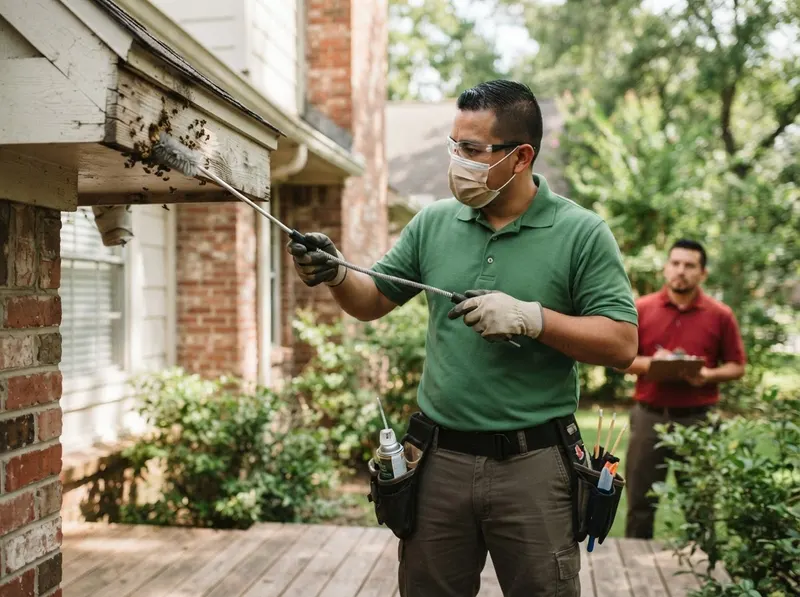
Stinging insect pressure in Harris County intensifies between March and October as subtropical humidity accelerates reproductive swarming. Red paper wasps routinely anchor umbrella-shaped combs beneath roof decking in…
Get My Free Estimate →(346) 776-1622
Stinging Insect and Carpenter Bee Removal in Houston, TX
Quick answer
  • Service scope: Identification, knockdown of active nests, directional void injection, aerosol or dust treat for wood galleries, and physical nest detachment.
  • Arrival timeframe: Same-day dispatch within 2 to 4 hours across Harris County for active perimeter nesting situations.
  • Pricing baseline: Baseline treatment starts at a $250 minimum charge, with final cost dictated by nest altitude, species density, and structural access requirements.
  • Targeted species: Red paper wasps, southern yellowjackets, bald-faced hornets, mud daubers, and carpenter bees (Xylocopa virginica).
  • Scheduling process: Confirmed by phone call to (346) 776-1622 or dispatch evaluation on-site.

Stinging insect pressure in Harris County intensifies between March and October as subtropical humidity accelerates reproductive swarming. Red paper wasps routinely anchor umbrella-shaped combs beneath roof decking in The Heights and Montrose, while aggressive southern yellowjackets colonize void spaces in Meyerland brick weep holes and perimeter landscaping. Carpenter bees specifically target untreated, unpainted softwoods, such as cedar pergolas in River Oaks and exposed pine fascia boards in Oak Forest and Kingwood. Females chew 0.5-inch circular entry holes, tunneling perpendicular to the grain before carving horizontal galleries up to 10 inches deep to lay eggs. If unaddressed, woodpeckers exploit these tunnels, compounding the physical destruction of exterior framing.

A single aerial spray rarely resolves an entrenched nesting site. Knocking down an exterior paper wasp comb eliminates visible adults, but leaving active carpenter bee tunnels untreated invites secondary wood rot and returning broods each spring. For structural wood infestations, targeted insecticidal dusts applied directly inside gallery entry points arrest larvae before workers seal the channels with wooden dowels or exterior caulk. When yellowjackets penetrate exterior weep holes near foundation expansion joints in Memorial or West University Place, specialized aerosol void injections reach the core colony without saturating adjacent landscape foliage or indoor living quarters.

Selecting localized physical extraction over whole-yard perimeter chemical fogging preserves domestic safety around family spaces and domestic pets. Direct void extraction limits chemical footprints while definitively removing defensive insects capable of stinging multiple times. Homeowners weighing standard perimeter insect barriers against dedicated stinging insect removal must consider that general surface coatings fail to penetrate interior roof soffits or protected carpenter bee galleries, making direct mechanical and localized dust intervention essential for long-term resolution.

Stinging Insect and Carpenter Bee Removal cost in Houston

Exposed Eave Wasp Nest Removal (Ground Level to 12 Feet)$250 - $350
High-Altitude Aerial Hornet or Wasp Nest (Second Story / 12-24 Feet)$325 - $475
Carpenter Bee Gallery Treatment and Entry Hole Sealing (Up to 5 Holes)$275 - $400
Extensive Carpenter Bee Remediation (Pergolas, Decks, Multiple Fascia Runs)$400 - $650
In-Wall Void or Underground Yellowjacket Colony Removal$350 - $550

Every job gets a firm, written price after a free on-site visit.

Common questions

How much does stinging insect and carpenter bee removal cost in Houston?
Professional stinging insect and carpenter bee removal in Houston begins at an absolute minimum service charge of $250. Standard single-story eave treatments average $250 to $350, while second-story heights or pervasive carpenter bee gallery sealing across large patio structures range between $400 and $650 following direct on-site inspection.
How do technicians treat active carpenter bee tunnels in Houston homes?
Technicians use precision directional tips to inject pressurized residual dust deep into each 0.5-inch circular bore hole, which reaches female bees and developing larvae inside the wood gallery. Once activity ceases, the entrance hole is plugged using treated wooden plugs or synthetic sealants to prevent moisture intrusion and subsequent brood re-infestation.
Are stinging insect treatments safe for pets and plants around Houston properties?
Direct nest removals and carpenter bee gallery treatments do not involve broadcast aerial sprays over grass or flowerbeds. Chemical agents are confined strictly to nest combs, exterior wall cavities, or wood voids, keeping pets and landscaping isolated from chemical contact once materials dry.
Can aggressive yellowjackets in Houston brick weep holes be removed without indoor damage?
Yes, technicians treat exterior wall voids through existing masonry weep screeds or exterior trim gaps using pressurized residual dusts that move through the cavity to reach the nesting queen. This method neutralizes the subterranean or internal void colony without requiring drywall demolition inside the living quarters.
How quickly can stinging insect removal be scheduled in Harris County?
Standard emergency dispatch for active, defensive stinging colonies near doorways or play areas operates within 2 to 4 hours across Houston neighborhoods including Clear Lake, Memorial, and West University Place by contacting (346) 776-1622.

Get started today

Tell us about your stinging insect and carpenter bee removal job in Houston and we'll send a clear, written quote, usually the same day.

Get your free Pest Control Service quote, Houston

We only use your ZIP to check availability, no spam.